
1
Managing Disagreements Constructively in International Teams
Managing Disagreements Constructively in International Teams
Content
This activity invites you to explore where disagreements come from, recognise your own instinctive style of dealing with conflict, and practise concrete tools for turning tension into constructive dialogue.
You can complete this activity on your own, but it works even better as part of a team or training group, since real conflict examples come from working with other people.
Check for a few manuals and presentation slides in the end of this activity.
Step 1 – Understand what a disagreement and a conflict are
A disagreement is simply a difference in opinions, ideas, or preferences about a specific issue. Example: two partner organisations disagree on the daily schedule of a youth exchange — how much free time versus structured activities.
A disagreement becomes a conflict once the difference starts touching real needs, interests, or values, and carries emotional weight or tension between people. Example: one organisation feels their input keeps getting overridden, and their approach to youth work isn't respected.
A conflict is a state of opposition between people, arising from incompatible needs, interests, or values. Example: the programme gets finalised without real agreement, and tension carries into the rest of the partnership.
Every conflict starts as a disagreement — but not every disagreement becomes a conflict. Whether it does depends on how it's handled, how important the issue is to each side, and whether people feel heard.
Step 2 – Explore where conflicts come from: the Wheel of Conflict
To understand the forces behind most conflicts, Bernard Mayer's Wheel of Conflict is a useful framework:
- At the centre of every conflict are human needs.
- These needs are affected by five surrounding forces: emotions, values, the way people communicate, the structure within which people interact, and history.
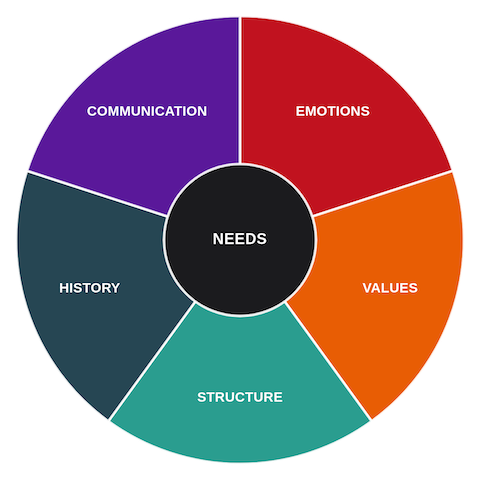
Optional reading: "The Wheel of Conflict" (Psychology Today): https://www.psychologytoday.com/us/blog/beyond-words/201204/the-wheel-of-conflict
Reflect on a real disagreement you experienced in an international or youth-work team:
- What triggered it?
- Which of the five forces (emotions, values, communication, structure, history) played the biggest role?
- How did the conflict show up for you — cognitively (you thought "this is a conflict"), emotionally (you felt it), and/or behaviourally (something actually happened or was said)?
Step 3 – Notice how conflict escalates
Most conflicts follow a similar escalation pattern:
Triggering comment → extra issues pile on → people take sides → communication distorts → positions harden → focus shifts to hurting rather than solving.
Recognising these symptoms early is one of the most useful conflict-management skills there is — it lets you intervene while the issue is still just a disagreement, before it escalates further.
Step 4 – Identify your own conflict-handling style
The Thomas-Kilmann Conflict Mode Instrument (TKI) is a widely used framework for understanding how people respond to conflict. It maps five styles across two dimensions: assertiveness (how much you pursue your own concerns) and cooperativeness (how much you attend to the other person's concerns).
- Competing – assertive, uncooperative ("I win, you lose")
- Collaborating – assertive, cooperative ("we both win")
- Compromising – moderate on both ("middle ground")
- Avoiding – unassertive, uncooperative ("withdraw or delay")
- Accommodating – unassertive, cooperative ("you win, I yield")
None of the five styles is inherently "wrong" — each is useful in some situations and unhelpful in others. The goal is to recognise your default style, and to be able to consciously choose a different one when the situation calls for it.
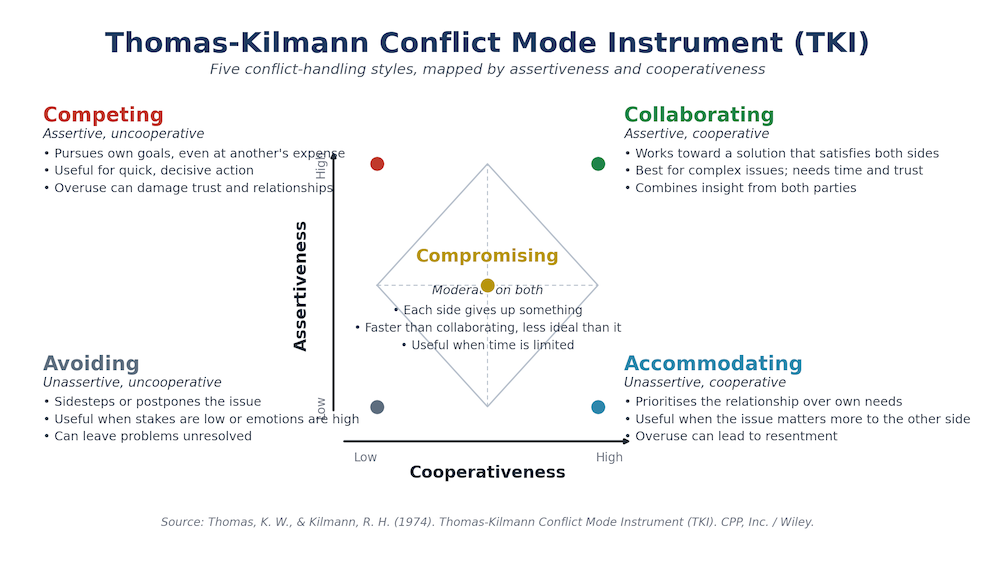
Watch: "Thomas-Kilmann Conflict Handling Modes model explained" (Karen Nesbitt, Oakridge)
Ask yourself: which style do you fall back on most often? When has that style served you well, and when has it worked against you?
Step 5 – Communicate constructively: active listening and I-messages
How a disagreement is discussed matters as much as what it's about. Two tools help keep communication constructive.
Active listening
Rather than just hearing what someone says, active listening means decoding the feelings and intent behind their words. Useful techniques:
Encourage – "Can you tell me more…?"
Clarify – "How did you react when… happened?"
Restate – "So, you see the problem as…"
Reflect – "It sounds like you feel angry about what happened."
Summarise – "You've spoken about A, B and C. Am I right?"
Validate – "I appreciate you taking the time to talk about this."
Watch: "The Art of Active Listening" (Harvard Business Review)
I-messages
In conflict, it's tempting to use "You-messages" that blame the other person ("You always ignore my ideas"). These rarely bring people together. I-messages focus on your own experience instead, which makes the other person less likely to feel attacked. A formal I-message has four parts:
- "I feel…" – states the feeling
- "when you…" – describes the specific behaviour (not the person)
- "because…" – describes the effect on you
- "and what I want is…" – states what would help
Example: instead of "You always ignore my ideas in planning calls," try: "I feel overlooked when my suggestions aren't discussed, because I want to contribute to the programme too. What I'd want is more space to share input before decisions are made."
Not all four parts are always needed, and the order can change — what matters is remembering to use the tool at all.
Watch the video about a Forum Theatre - a method allowing to explore unresolved situations, try several ways of behaviour and emancipate oneself from the situations that cause tensions, conflict and unclear relationships.
Source: project Youtrain, implemented by the International Youth Work Trainers Guild.
*****
This activity supports youth workers competence development in "Dealing with frustration in a constructive manner". Activity content and badge issuing criteria are aligned with the European Training Strategy (ETS) competence model for youth workers working internationally. In particular, it addresses the following competences:
- Knowledge how to deal with emotions
- Ability to deal with emotions
- Knowledge about conflict prevention and transformation
- Openness to and ready for new challenges
Want to endorse our organisation, this activity and/or badge — send us an email! Contact us at info@awero.org for further questions.

Resources
Get activity badge
Conflicts Navigator Get this badge
This badge shows that the earner understands where disagreements and conflicts come from, recognises their own conflict-handling style, and can apply constructive communication tools (active listening and I-messages) to manage disagreements within international and youth-work teams.
To get this badge, a person needed to suggest at least one specific action or strategy for handling disagreement in a constructive way.
Activity content and badge issuing criteria aligned with the European Training Strategy (ETS) competence model for youth workers to work internationally.
Tasks
Task no.1
Evidence verified by: აქტივობის ერთი ორგანიზატორი
Suggest at least one specific action or strategy for handling disagreement in a constructive way.
Skills
#Dealing with frustration in a constructive manner
Organisers
Awero
Badge issuer recognized with

Awero not-for-profit organisation manages this platform and develops it together with leading educational organisations. The European Union's programme Erasmus+ granted co-funding for building the first version of this platform. Contact support@awero.org.
Platform
Discover
Change to another language: