
13
Training Course for Youth Workers on Collaborating in Youth Worker Teams
Δευτέρα, 31 Αυγούστου 2026, 15:00 - Κυριακή, 6 Σεπτεμβρίου 2026, 07:00
Training Course for Youth Workers on Collaborating in Youth Worker Teams
Δευτέρα, 31 Αυγούστου 2026, 15:00 - Κυριακή, 6 Σεπτεμβρίου 2026, 07:00
Σχετικά
Dates: 31 August - 6 September, 2026
Venue: Trakai region, Lithuania
Awero team and its partners are offering a 5th modular training for youth workers, aligned to the European Training Strategy (ETS) competence model.
Objectives
The training course will contribute to the development of youth workers’ competencies in the area of “Collaborating in teams”*:
- Awareness of the team processes and how they affect the team’s effectiveness
- Ability to build team spirit and trust
- Ability to match team member competences to the objectives of the activity
- Managing disagreements constructively
- Encouraging and involving other team members
- Learning with and from team members.
*“Collaborating in teams” means that the youth worker contributes to team work and maintains good working relations with everyone involved with the project. The youth worker motivates and supports colleagues in achieving given objectives. This competence area also includes systemic cooperation and responsibility in an international context.
Highlights of this training activity
- This course is part of the Erasmus+ long-term accreditation programme implemented by NGO Awero together with it’s partners. More about the programme: https://awero.org/en/ets-modular-trainings-and-certfication
- Aligned to the ETS competence model for Youth Workers - the course objectives and content are aligned with professional youth workers’ competences in international youth work settings
- Certified training - the broad coalition of partners will create opportunities for the course participants to assess, validate and recognise competence development at the international level and in specific countries (if possible).
- Digital friendly - the training and competence assessment methodology and activities will include using digital tools and platforms, for example, YouthWorkPathways.net platform and digital Open Badges.
- Long-term development opportunity - participants willing to continue to develop their professional youth work competences will be invited to apply for the upcoming training courses on other competence areas.
- Endorsed by the broad partnership of Cities of Learning members national youth worker associations and international organisations from the youth work field.
Training programme
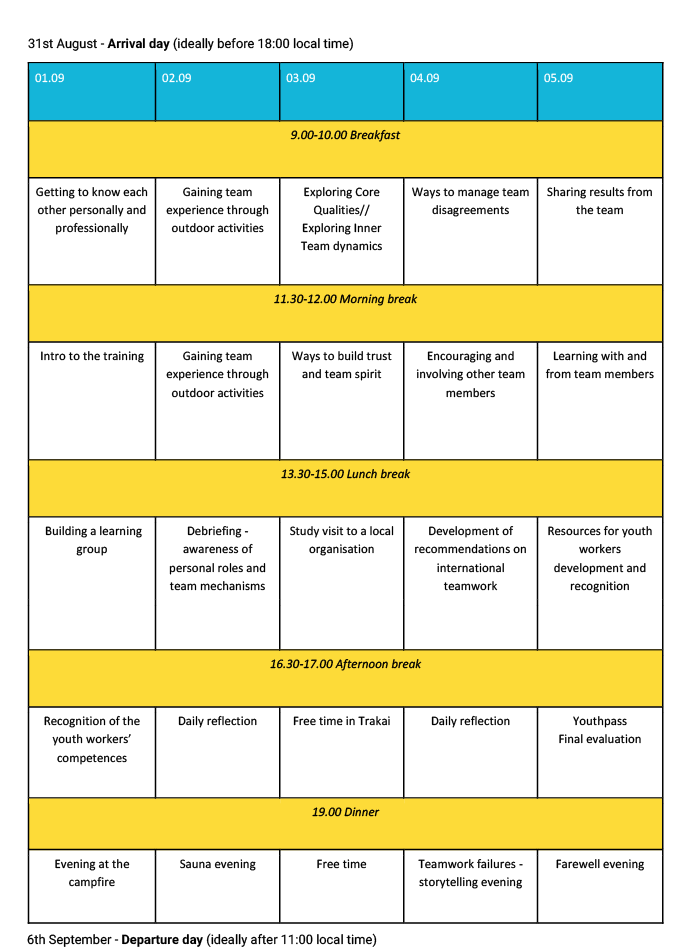
Digital credentials and certification
- This training activity is a unique opportunity for participants to use up-to-date and digital recognition solutions, such as digital Open Badges and https://youthworkpathways.net platform.
- Participants can use the 360-degree competence assessment, earn digital badges, and receive certificates that prove their competence development.
- Youthpass process and certificate will be offered to participants joining this training programme.
- Watch this video explaining how partners build competence assessment, validation and recognition systems: https://bit.ly/YW-TrCertvideo
Organisers
For more information, please contact the organisers:
Awero, info@awero.org
Trainers' team
Αποκτήστε το σήμα δραστηριότητας
4
Youth Workers' Training on Collaborating in Teams Αποκτήστε αυτό το σήμα
This badge certificate is a micro-credential which confirms that the person completed the international youth workers' training focusing on collaborating in teams in international youth work settings. The residential training activity occurred from 31 August to 6 September 2026 in Trakai, Lithuania. The course participant carried out preparation activities before and follow-up activities after the course.
60 hours of work (equals 2 ECTS) is the estimated time the learner invested to achieve the following learning outcomes at European Qualification Framework Level 5, across all seven descriptor dimensions:
- Knowledge. Demonstrates comprehensive, specialised knowledge of team dynamics, roles, conflict resolution and intercultural cooperation in international youth work contexts, and explains how these shape team effectiveness in unpredictable international settings.
- Application: Applies knowledge of team member competences and working styles flexibly and inventively to structure collaboration and role distribution in unpredictable international youth work team situations, without relying on preset procedures.
- Problem-solving: Identifies and analyses complex interpersonal and intercultural tensions within international youth work teams and resolves them constructively and creatively, without a prescribed plan.
- Learning & Development: Critically evaluates own collaborative practice across a programme of international learning activities, identifies development needs, and designs a self-directed three-month professional development plan in the competence area of collaborating in teams.
- Information Skills: Gathers, evaluates and systematically applies relevant information about team functioning — through direct observation, structured peer feedback and critical reflection — to improve collaborative practice in international youth work settings.
- Communication: Communicates effectively across cultural and professional differences in international youth work team settings, including in situations of tension and disagreement, adapting approach to the needs and styles of individual team members.
- Responsibility & Autonomy: Takes autonomous responsibility for own contribution to collective team outcomes and for ongoing professional development in the competence area of collaborating in teams in international youth work.
This training programme involves experienced adult practitioners. Learning outcomes may be demonstrated through evidence drawn from prior professional practice in (international) youth work teams, as well as from activities and situations arising during the training itself, provided all evidence is assessed at EQF Level 5.
Learning Pathway and Assessment
The participant completed a flexible learning pathway through non-formal training and informal learning activities across a five-day residential programme.
During the programme, participants worked towards nine formative progress badges, each linked to specific training sessions and competence areas within the European Training Strategy (ETS) Collaborating in Teams model. These progress badges are developmental checkpoints designed to scaffold competence-building and deepen engagement with the learning content. They do not carry a qualification level and do not constitute the assessment instrument for this micro-credential.
The EQF Level 5 assessment is performed exclusively through the course completion badge — Collaborating in International Youth Work Teams — which assesses all seven descriptor dimensions against stated Level 5 criteria.
To be eligible to claim this badge, participants were required to:
- Earn the two most demanding programme progress badges — Teamwork Resource Creator and Teamwork Patterns Navigator — as mandatory prerequisites;
- Earn the 3√ó3√ó3 Intentional Learning badge, confirming completion of a structured three-month professional development plan with three goals and three accountability partners;
- Earn at least 60% of the remaining six programme progress badges (at least 4 of 6).
Participants who met the prerequisite badge requirements submitted evidence for the capstone badge through two assessment instruments:
- A personal video reflection (4–6 minutes), submitted within three weeks of the training programme ending, in which the participant reflects unscripted on their learning journey — identifying at least two specific moments from the programme that shaped their understanding of effective collaboration in international youth work teams. The extended submission window allows time to process and digest learning before reflection.
- A 360-degree peer competence assessment, completed by two fellow programme participants from different countries using the structured ETS Collaborating in Teams competence assessment model. Assessors name specific observable moments from the training programme when rating the badge earner's competences. Assessments are submitted directly by the assessors through the Cities of Learning platform.
Quality Assurance
The course training team assessed progress badge evidence, verifying submissions against predefined, publicly stated criteria anchored in the ETS competence model. Peer review was integral to the process: structured daily peer reflection and peer endorsement requirements within individual badge tasks supported participants' understanding and self-assessment of their learning outcomes.
Assessment of the course completion badge — the instrument through which EQF Level 5 competence is formally evaluated — was carried out jointly by the course training team and an independent external reviewer who did not participate in delivering the training. The external reviewer verified that submitted evidence met the stated EQF Level 5 descriptor standards across all seven dimensions before the badge was approved and issued.
This certification is aligned with the European Training Strategy (ETS) competence model for youth workers working internationally, specifically the competence area of Collaborating in Teams.
The training organiser holds approved Erasmus+ Accreditation to deliver learning mobility for youth workers and trainers in compliance with the quality standards of EU-funded mobility programmes in the field of youth. The Erasmus+ and the European Solidarity Corps Programmes National Agency in Lithuania evaluated the quality and approved the accreditation for this training activity.
Πρέπει να ολοκληρώσετε όλες τις εργασίες για να αποκτήσετε το σήμα
Εργασίες
Αρ. Εργασίας 1
Τα στοιχεία επαληθεύτηκαν από: 2 διοργανωτές δραστηριοτήτων
Submit a personal video reflection (4–6 minutes).
In the video, reflect on what you have learned about effective collaboration in international youth worker teams by identifying at least two specific moments from the training programme that shaped your understanding of teamwork.
Αρ. Εργασίας 2
Τα στοιχεία επαληθεύτηκαν από: 2 διοργανωτές δραστηριοτήτων
Submit screenshots of 2 assessments given by other course participants.
Using the 360-degree peer competence assessment available on www.youthworkpathways.net, ask two fellow programme participants from different countries to assess and give feedback on your competences in the area of Collaborating in Teams.
Διοργανωτές
Awero
Cities of Learning Network
Badge issuer recognized with

Η Badgecraft φιλοξενεί αυτήν την πλατφόρμα και την αναπτύσσει μαζί με κορυφαίους εκπαιδευτικούς οργανισμούς. Το πρόγραμμα Erasmus + της Ευρωπαϊκής Ένωσης συγχρηματοδότησε την κατασκευή της πρώτης έκδοσης αυτής της πλατφόρμας. Επικοινωνήστε με το support@badgecraft.eu.
Πλατφόρμα
Αλλαγή γλώσσας: