
1
Working in intercultural teams of youth workers
Working in intercultural teams of youth workers
Content
Working in international youth work means cooperating with people who bring diverse experiences, backgrounds, communication styles, values, and expectations.
This diversity can be a valuable resource for teamwork, but it can also lead to misunderstandings, tensions or different interpretations of what is happening.
Culture is only one of the factors influencing how we behave in teams, and much of its influence may not be immediately visible. Personal preferences, professional and organisational cultures, previous experiences, social realities, and other aspects of identity can all influence how we communicate, make decisions, manage time, distribute responsibilities, or respond to disagreement. This activity develops your intercultural sensitivity: your ability to notice your own assumptions and to read others’ behaviour in its cultural and personal context, rather than at face value.
The Training Essentials T-Kit highlights that intercultural teams can bring complementary competences, experiences and perspectives. At the same time, working across different approaches and views requires flexibility, openness and an effort to understand other team members’ perspectives. When these differences are recognised and worked with, diversity can contribute to richer learning and more effective teamwork.
This activity invites you to experience intercultural team dynamics through simulation and reflect on what happens when different cultural patterns meet.
By completing this activity, you will be able to:
- Identify how different cultural patterns can influence communication and cooperation in a team;
- Recognise how behaviours can be interpreted differently depending on cultural and personal perspectives;
- Describe your own reactions, assumptions and ways of interpreting others;
- Explain how cultural diversity can become both a challenge and a resource for teamwork.
Step 1. Experience intercultural teamwork through simulation
Participate in a simulation role-play in which different groups receive specific cultural characteristics, behaviours or ways of interacting. During the simulation, you will meet and cooperate with people representing other cultures while staying in your assigned role.
Pay attention to how you communicate, make decisions, react to others and try to achieve shared goals. Notice what happens when different expectations, behaviours and ways of working meet. At the end of the simulation, consciously step out of your assigned role before moving into the reflection.
Step 2. Debrief the experience
Start by sharing one word that best describes your experience. Then reflect individually, in smaller groups and together:
- What happened during the simulation?
- How did you perceive the other cultures? How did others perceive your culture?
- How did it feel to behave according to your assigned cultural role? What felt comfortable or uncomfortable?
- How similar or different was your assigned culture from cultural patterns you recognise in your own life?
- What can you recognise from this experience in real intercultural teamwork?
Step 3. Connect the experience to intercultural teamwork
Explore the cultural iceberg and consider how it can help explain what happened during the simulation. Some elements of culture are relatively visible, while others – such as values, assumptions, attitudes towards authority, communication patterns, perceptions of time, or approaches to disagreement – may remain less visible yet still influence teamwork.
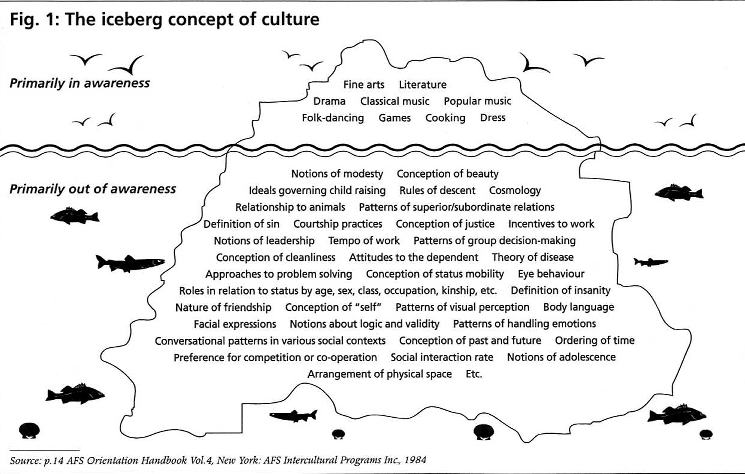
Think of the culture as a multifaceted phenomenon, rather than something determined solely by nationality. When working in teams, our behaviour can be influenced by many overlapping cultural contexts and identities: national and regional backgrounds, organisations, professions, generations, languages, educational experiences, communities and personal histories.
The Training Essentials T-Kit points out that people working together can bring different ways of learning and working, different priorities, abilities and preferred methods. Discussing these differences and finding a balance can help teams make better use of their diversity. The T-Kit on Intercultural Learning also emphasises that diversity in cultural, linguistic and social backgrounds can help create conditions for intercultural learning.
At the end of the activity, reflect on what you discovered about yourself, about cooperating with people whose behaviours, assumptions or approaches may differ from your own, and on what you want to pay more attention to when working in intercultural teams in the future.
Inspiring resources:
- T-Kit 6: Training Essentials, chapter 2.1.1, “Why work in a multicultural team”, EU–Council of Europe Youth Partnership
- T-Kit 4: Intercultural Learning, EU–Council of Europe Youth Partnership.
Go to the badge and submit evidence covering:
- 2–3 insights you gained from the intercultural teamwork simulation
- How a behaviour — yours or someone else's — was interpreted differently than intended, and what that revealed about your own perceptions or assumptions
- A reflection on how visible and less visible aspects of culture can affect communication and cooperation in teams
- 2–3 things you want to pay attention to when working in intercultural teams in the future
The Awero organisation created this educational resource and activity for the Erasmus+ Accreditation training.
This activity supports youth workers’ competence development related to intercultural teamwork and cooperation.

Get activity badge
Intercultural Team Navigator Get this badge
The badge earner experienced and reflected on intercultural team dynamics through a simulated teamwork exercise, exploring how different cultural patterns, assumptions and behaviours can influence cooperation in international youth work.
To earn the badge, the youth worker:
- Participated in an intercultural teamwork simulation.
- Described their own reactions, assumptions and interpretations during the simulation.
- Identified visible and less visible dimensions of culture and how they influence teamwork.
- Identified ways to work more consciously with cultural differences and diversity in teams.
Learning represented by this badge is aligned to the ETS competence model for youth workers, specifically, aspects of reflecting on own values and sense of belonging to increase self-awareness of difference, and recognising and interpreting behaviour in a culturally appropriate manner.
EQF level: Level 4
Estimated learning effort: 3 hours
Tasks
Task no.1
Evidence verified by: one activity organiser
To get this badge:
- Share 2–3 insights you gained from the intercultural simulation role-play activity.
- Describe a behaviour — yours or someone else’s — that was interpreted differently than intended, and what that revealed about your own perceptions or assumptions.
- Reflect on how visible and less visible aspects of culture can affect communication and cooperation in teams.
- Share 2–3 things you want to pay attention to when working in intercultural teams in the future.
Skills
#Self-reflecting on their own values, beliefs and attitudes
#Identifying diversity, strengths and weaknesses in the team
Organisers
Awero
Cities of Learning Network
Badge issuer recognized with

Awero not-for-profit organisation manages this platform and develops it together with leading educational organisations. The European Union's programme Erasmus+ granted co-funding for building the first version of this platform. Contact support@awero.org.
Platform
Change to another language: